Agent Registration
Agents are not provisioned ahead of time. They register themselves to Opstage on first start, using a one-time registration token that the administrator created in advance.
Why "Agent registration" instead of "service provisioning"?
Capsule Services are diverse and often dynamic — a worker can be spun up per task, an account-pool worker can run on a laptop, a Cloud customer's agent runs inside the customer's environment. Pre-provisioning every service into a central registry doesn't scale.
Instead:
- The administrator creates registration tokens: short-lived, single-use credentials.
- The Agent uses a registration token once to bootstrap.
- Opstage issues a long-lived agent token in exchange.
- The agent stores the agent token locally and uses it for every subsequent call.
This means the Agent is the active party. The Backend never needs inbound access to the service.
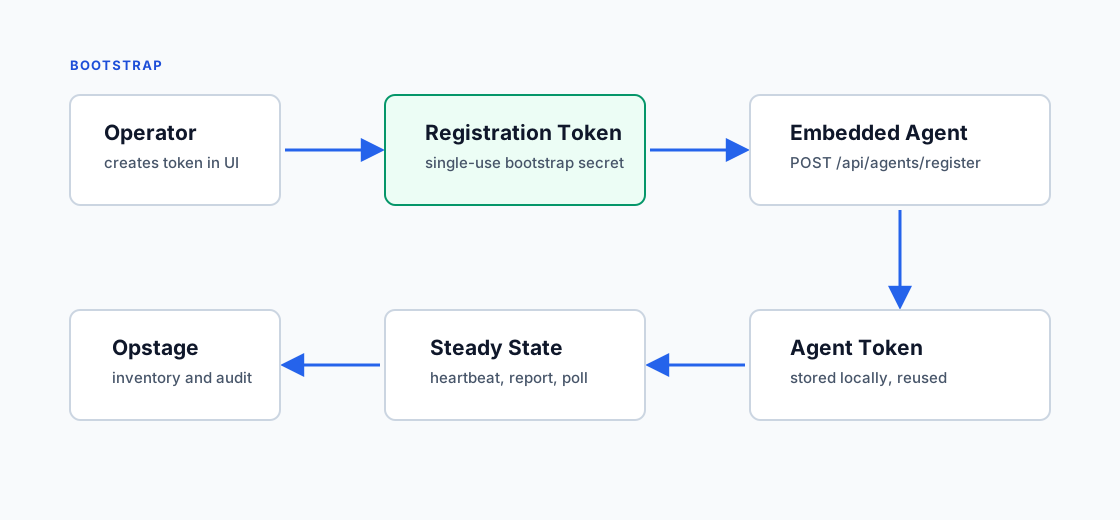
End-to-end flow
   Admin creates registration token
                 │
                 ▼
   Agent starts with registration token
                 │
                 ▼
   Agent registers to Backend
                 │
                 ▼
   Backend issues agent token
                 │
                 ▼
   Agent sends heartbeats and service reports
                 │
                 ▼
   Backend displays Agent and Capsule Service state
                 │
                 ▼
   Operator triggers an action in the UI
                 │
                 ▼
   Backend creates a command
                 │
                 ▼
   Agent polls and executes the command
                 │
                 ▼
   Agent reports result; Backend writes audit
Step by step
Operator creates a registration token. In Opstage UI → Registration Tokens → Create. The one-time token (
opstage_reg_...) is shown once. Only its hash is persisted.Agent boots with the registration token. Typically passed as
OPSTAGE_REGISTRATION_TOKEN. The agent posts it toPOST /api/agents/registertogether with its agent identity (code,name,runtime) and the initial Capsule Service manifest. Hostname and SDK version are planned for v0.2 and are not reported in v0.1.Backend validates the token. Looks up the token by hash, checks
expiresAt,revokedAt, and the single-use status flag. If invalid →401.Backend issues an agent token. A new agent record is created. A fresh agent token (
opstage_agent_...) is generated, hashed, and stored. The plaintext token is returned to the agent once.Agent persists the agent token. Saved to a token file (e.g.
./data/agent-token.txt). All subsequent calls (heartbeat, report, poll) use this token.Agent heartbeats. Every ~30s the agent sends a heartbeat. If the backend hasn't seen a heartbeat in
OPSTAGE_AGENT_OFFLINE_THRESHOLD_SECONDS(default 90), the agent is markedOFFLINE.Agent reports services. On register and on change, the agent publishes its Capsule Service manifests (code, name, version, declared actions, health, configs).
Backend computes effectiveStatus per service.
HEALTHY/UNHEALTHY/STALE/OFFLINEbased on agent state plus last-report freshness.
Agent health providers return protocol-level HealthStatus values: UP, DEGRADED, DOWN, UNKNOWN.
Opstage may derive an operator-facing effectiveStatus: HEALTHY, UNHEALTHY, STALE, OFFLINE.
What happens when things go wrong
- Registration token expired → register call fails with
REGISTRATION_TOKEN_EXPIRED. - Registration token revoked → register call fails with
REGISTRATION_TOKEN_REVOKED. - Agent token revoked → all authenticated calls fail with
UNAUTHORIZED; the agent must be re-registered. - Agent disabled → calls fail with
AGENT_DISABLED; operator can re-enable from the console. - Agent silent for too long → marked
OFFLINE; its services move toSTALE.
Security properties
- The Backend stores only hashes of registration tokens and agent tokens.
- The Agent always initiates the connection; the Backend never opens a socket to the agent.
- A leaked agent token can be revoked from the console; the agent must then re-register.
→ See Token Model for the full security story.